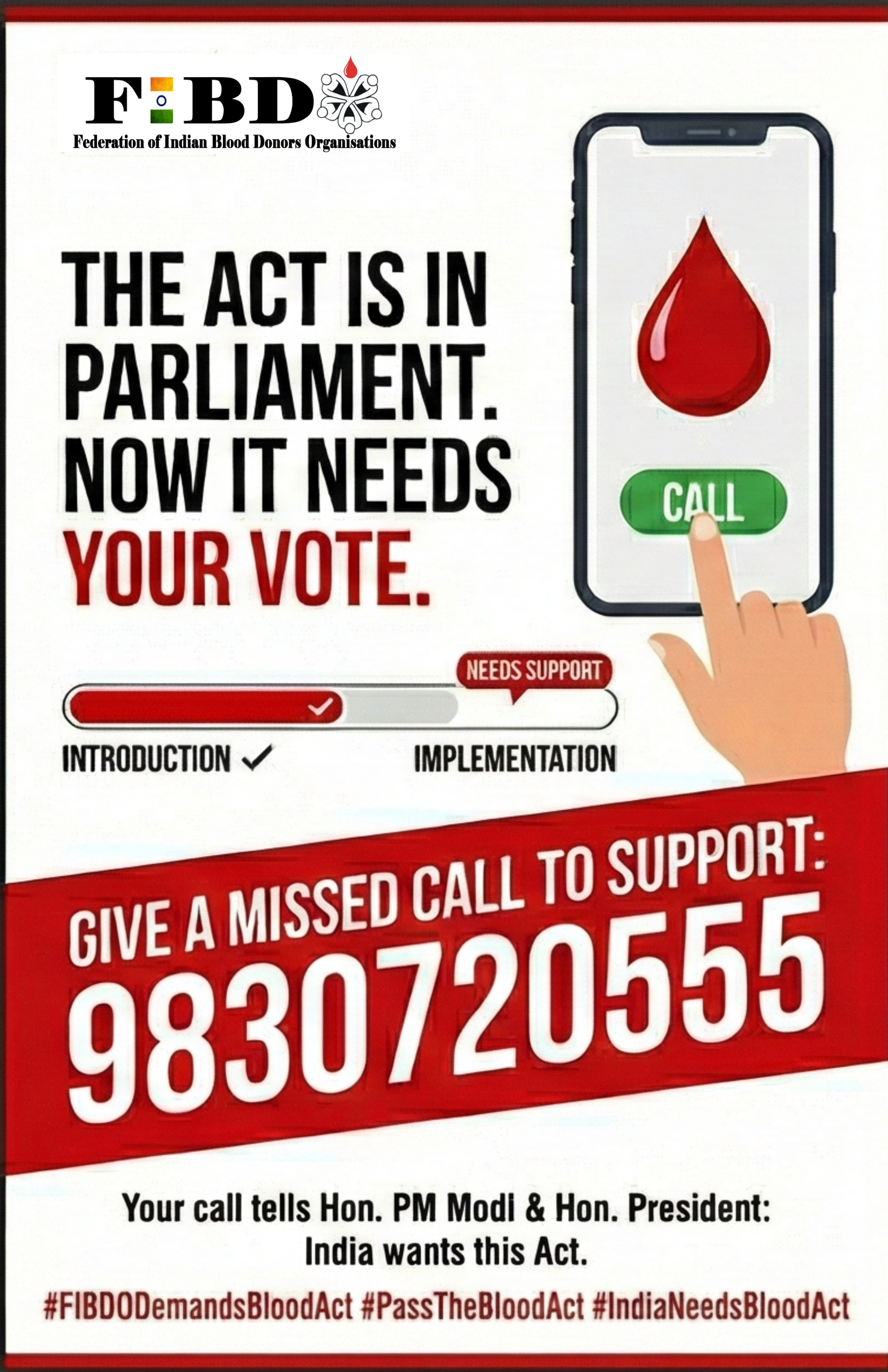
Download IEC Materials, Presentation Related to
National Blood Transfusion Bill, 2025
The National Blood Transfusion Bill, 2025, is a proposed legislation recently introduced in both the Lok Sabha and Rajya Sabha. It aims to create a dedicated legal framework to regulate the entire spectrum of blood services in India—from collection and testing to storage and transfusion.
Core Goal: To treat blood not just as a “drug” (as currently classified) but as a life-saving public resource that requires specialized governance.
Key Proposal: It seeks to establish a statutory body called the National Blood Transfusion Authority (NBTA) to oversee these services nationwide.
Currently, blood banks in India are regulated under the Drugs and Cosmetics Act, 1940, which treats blood primarily as a pharmaceutical product. This has led to several gaps:
Fragmented System: There is no central authority dedicated solely to blood safety, leading to inconsistent standards across states.
Safety Concerns: Without uniform, stringent monitoring, there are risks of transfusion-transmissible infections (like HIV or Hepatitis) due to poor testing in some unregulated or smaller centers.
Shortages & “Blood Deserts”: Efficient distribution is lacking, causing surpluses in cities while rural areas face acute shortages.
The Bill is designed to directly impact patient safety and accessibility:
Guaranteed Safety: Patients can be assured that the blood they receive has undergone standardized, high-quality testing, regardless of where they are in India.
Better Access: A centralized authority will help coordinate supply, ensuring blood reaches patients in need (e.g., accident victims, surgery patients) more actively.
Grievance Redressal: It creates a mechanism for patients to report negligence or unsafe practices, holding blood banks accountable.
The Bill proposes a comprehensive overhaul of the current system. Key coverage areas include:
National Blood Transfusion Authority (NBTA): A central body to set standards, issue guidelines, and monitor compliance.
Standardization: Uniform protocols for donor selection, blood collection, testing, and storage.
Haemovigilance: A mandatory surveillance system to track and report adverse reactions to blood transfusions (e.g., if a patient falls ill after a transfusion).
Voluntary Donation: It explicitly promotes and regulates voluntary, non-remunerated blood donation to reduce reliance on “replacement donors” (family members forced to donate in emergencies).
Penalties: Stringent legal penalties for blood centers that violate safety norms or operate without a license.
This legislation is critical because:
It’s a Lifeline for Chronic Patients: For people with Thalassemia, Sickle Cell Anaemia, and Hemophilia, safe blood is a daily necessity, not a choice. This bill ensures their lifeline is not compromised by poor quality.
Public Trust: It restores faith in the medical system by ensuring that the blood supply chain is transparent and ethical.
Global Standards: It aligns India’s blood transfusion services with international best practices, moving away from a fragmented approach to a unified, national safety net.
One of the most significant goals of this Bill is to phase out the “replacement donor” system, where hospitals force patient families to bring a donor in exchange for blood.
The Change: The Bill mandates a shift toward 100% voluntary, non-remunerated blood donation.
The Benefit: In emergencies, families will not be burdened with finding a donor immediately. Instead, blood banks will be required to maintain sufficient stocks through regular voluntary drives, making blood available “off the shelf” based on need, not exchange.
Currently, illegal hoarding and selling of blood occur due to weak monitoring. The Bill introduces strict measures to curb this:
traceability: It proposes a digital tracking system (likely expanding on the e-RaktKosh portal) where every unit of blood is tracked from “vein to vein” (donor to recipient).
Standardized Charges: The National Blood Transfusion Authority (NBTA) will have the power to regulate service charges, ensuring that private blood banks cannot charge exorbitant processing fees under the guise of “administrative costs.”
Criminal Penalties: Selling blood for profit or operating an unlicensed storage center will attract harsh prison sentences and heavy fines.
Uniform Standards: Many smaller centers currently operate with limited equipment. Under the new Bill, they must meet the National Standards for safety, storage, and testing to retain their license.
Hub-and-Spoke Model: Smaller centers that cannot meet high testing standards may be converted into “Blood Storage Centers” (spokes). They will not collect blood but will receive safe, pre-tested blood from larger, fully equipped “Mother Blood Banks” (hubs). This ensures that a patient in a rural nursing home gets blood as safe as a patient in a top city hospital.
Yes. The definition of “Blood” and “Blood Products” in the Bill is broad and forward-looking.
It brings apheresis (separating platelets/plasma directly from a donor) and stem cell/cord blood banking under the same regulatory umbrella.
This prevents unregulated clinics from offering unproven “stem cell therapies” and ensures that cord blood banks follow strict ethical and safety guidelines for storage.
The Bill establishes a clear Grievance Redressal Mechanism.
Previously, patients had to rely on general consumer courts or scattered medical councils.
Now, the NBTA (National Authority) and its state counterparts will have dedicated wings to handle complaints regarding blood denial, unsafe practices, or overcharging. This empowers the “common man” to demand accountability directly.
यह विधेयक 2025 में संसद के दोनों सदनों (लोकसभा और राज्यसभा) में पेश किया गया एक प्रस्तावित कानून है। इसका उद्देश्य भारत में रक्त सेवाओं—रक्त संग्रह, जांच से लेकर आधान (ट्रांसफ्यूजन) तक—के पूरे स्पेक्ट्रम को विनियमित करने के लिए एक समर्पित कानूनी ढांचा तैयार करना है।
मुख्य लक्ष्य: रक्त को केवल एक “दवा” (जैसा कि वर्तमान में माना जाता है) के रूप में नहीं, बल्कि एक जीवन रक्षक सार्वजनिक संसाधन के रूप में देखना जिसके लिए विशेष निगरानी की आवश्यकता है।
प्रमुख प्रस्ताव: यह इन सेवाओं की निगरानी के लिए ‘राष्ट्रीय रक्त आधान प्राधिकरण’ (NBTA) नामक एक वैधानिक निकाय की स्थापना करना चाहता है।
वर्तमान में, भारत में ब्लड बैंक ड्रग्स एंड कॉस्मेटिक्स एक्ट, 1940 के तहत विनियमित होते हैं, जो रक्त को मुख्य रूप से एक दवा उत्पाद मानता है। इसके कारण कई कमियां हैं:
बिखरी हुई व्यवस्था: रक्त सुरक्षा के लिए समर्पित कोई केंद्रीय प्राधिकरण नहीं है, जिससे राज्यों के बीच मानकों में अंतर होता है।
सुरक्षा चिंताएं: सख्त निगरानी की कमी के कारण, कुछ जगहों पर खराब जांच से संक्रमण (जैसे एचआईवी या हेपेटाइटिस) का खतरा बना रहता है।
कमी: कुशल वितरण की कमी के कारण शहरों में अतिरिक्त रक्त होता है जबकि ग्रामीण क्षेत्रों में भारी कमी का सामना करना पड़ता है।
यह विधेयक सीधे तौर पर रोगी की सुरक्षा और सुविधा के लिए बनाया गया है:
सुरक्षा की गारंटी: मरीज निश्चिंत हो सकते हैं कि उन्हें मिलने वाला रक्त मानकीकृत और उच्च गुणवत्ता वाली जांच से गुजरा है, चाहे वे भारत में कहीं भी हों।
बेहतर पहुंच: एक केंद्रीय प्राधिकरण आपूर्ति का समन्वय करेगा, जिससे दुर्घटना पीड़ितों या सर्जरी के मरीजों तक रक्त आसानी से पहुंचेगा।
जवाबदेही: यह लापरवाही या असुरक्षित प्रथाओं की रिपोर्ट करने के लिए एक तंत्र बनाता है, जिससे ब्लड बैंक जवाबदेह बनेंगे।
इस विधेयक में मौजूदा व्यवस्था में बड़े बदलाव का प्रस्ताव है, जिसमें शामिल हैं:
राष्ट्रीय रक्त आधान प्राधिकरण (NBTA): मानक तय करने और निगरानी के लिए एक केंद्रीय संस्था।
मानकीकरण: डोनर चयन, रक्त संग्रह, जांच और भंडारण के लिए एक समान प्रोटोकॉल।
हीमोविजिलेंस (Haemovigilance): रक्त आधान से होने वाले प्रतिकूल प्रभावों (जैसे अगर कोई मरीज खून चढ़ाने के बाद बीमार हो जाए) को ट्रैक और रिपोर्ट करने के लिए अनिवार्य निगरानी प्रणाली।
स्वैच्छिक रक्तदान: यह स्वैच्छिक रक्तदान को बढ़ावा देता है और “रिप्लेसमेंट डोनर्स” (मजबूरी में रक्तदान करने वाले परिवार के सदस्य) पर निर्भरता कम करता है।
यह कानून इसलिए महत्वपूर्ण है क्योंकि:
दीर्घकालिक रोगियों के लिए जीवनरेखा: थैलेसीमिया, सिकल सेल एनीमिया और हीमोफिलिया के मरीजों के लिए सुरक्षित रक्त एक दैनिक आवश्यकता है। यह विधेयक सुनिश्चित करता है कि उन्हें खराब गुणवत्ता वाला रक्त न मिले।
जनता का भरोसा: यह रक्त आपूर्ति श्रृंखला को पारदर्शी और नैतिक बनाकर चिकित्सा प्रणाली में विश्वास बहाल करता है।
वैश्विक मानक: यह भारत की रक्त सेवाओं को अंतरराष्ट्रीय मानकों के अनुरूप बनाता है।
इस विधेयक का एक बड़ा लक्ष्य “रिप्लेसमेंट डोनर” प्रणाली को समाप्त करना है, जहाँ अस्पतालों द्वारा परिवार को खून के बदले डोनर लाने के लिए मजबूर किया जाता है।
बदलाव: विधेयक 100% स्वैच्छिक, बिना पैसे के रक्तदान की ओर बढ़ने का आदेश देता है।
फायदा: आपात स्थिति में, परिवारों को तुरंत डोनर खोजने का बोझ नहीं उठाना पड़ेगा। ब्लड बैंकों को नियमित स्वैच्छिक शिविरों के माध्यम से पर्याप्त स्टॉक रखना होगा, ताकि जरूरत के आधार पर रक्त उपलब्ध हो सके, न कि बदले में डोनर लाने पर।
कमजोर निगरानी के कारण रक्त की अवैध जमाखोरी और बिक्री होती है। विधेयक इसे रोकने के लिए सख्त कदम उठाता है:
ट्रैकिंग: यह एक डिजिटल ट्रैकिंग सिस्टम का प्रस्ताव करता है जहाँ रक्त की हर यूनिट को डोनर से लेकर मरीज तक ट्रैक किया जाएगा।
मानकीकृत शुल्क: प्राधिकरण (NBTA) सर्विस चार्ज को विनियमित करेगा, ताकि निजी ब्लड बैंक “प्रशासनिक लागत” के नाम पर मनमाना पैसा न वसूल सकें।
सजा: मुनाफे के लिए खून बेचना या बिना लाइसेंस के सेंटर चलाना अपराध माना जाएगा, जिसके लिए जेल और भारी जुर्माने का प्रावधान है।
- समान मानक: कई छोटे केंद्र अभी सीमित उपकरणों के साथ चलते हैं। नए विधेयक के तहत, उन्हें अपना लाइसेंस बनाए रखने के लिए सुरक्षा और जांच के राष्ट्रीय मानकों को पूरा करना होगा।
- हब-एंड-स्पोक मॉडल: जो छोटे केंद्र बड़े मानकों को पूरा नहीं कर सकते, उन्हें “रक्त भंडारण केंद्र” (Blood Storage Centers) में बदला जा सकता है। वे रक्त संग्रह नहीं करेंगे, बल्कि बड़े और पूरी तरह से सुसज्जित “मदर ब्लड बैंकों” से सुरक्षित, पहले से जाँचा हुआ रक्त प्राप्त करेंगे। इससे ग्रामीण मरीजों को भी शहर जैसा सुरक्षित रक्त मिलेगा।
हाँ। विधेयक में “रक्त” और “रक्त उत्पादों” की परिभाषा व्यापक है।
यह एफेरेसिस (डोनर से सीधे प्लेटलेट्स/प्लाज्मा अलग करना) और स्टेम सेल/कॉर्ड ब्लड बैंकिंग को भी इसी कानून के तहत लाता है।
यह बिना नियम के चल रहे क्लीनिकों को रोकने और यह सुनिश्चित करने में मदद करेगा कि कॉर्ड ब्लड बैंक भंडारण के लिए सख्त नैतिक और सुरक्षा दिशानिर्देशों का पालन करें।
यह विधेयक एक स्पष्ट शिकायत निवारण तंत्र (Grievance Redressal Mechanism) स्थापित करता है।
पहले मरीजों को सामान्य उपभोक्ता अदालतों या मेडिकल काउंसिल पर निर्भर रहना पड़ता था।
अब, NBTA (राष्ट्रीय प्राधिकरण) और इसकी राज्य शाखाओं के पास रक्त देने से मना करने, असुरक्षित तरीकों या अधिक पैसे वसूलने की शिकायतों को संभालने के लिए समर्पित विभाग होंगे। यह आम आदमी को सीधे जवाबदेही मांगने का अधिकार देता है।